

How To Install Aluminum Soffit And Fascia Video
How to Install Aluminum Soffits That are Maintenance-Free
You lot'll never have to pigment the roof overhangs again!
 Time
Time
Multiple Days
 Complexity
Intermediate
 Cost
Cost
$501-1000
Introduction
Wrap the soffits and fascias on your home with prefinished aluminum and you lot'll never have to scrape, prime or paint those roof edges once again. New aluminum soffits (the underside of eaves) and fascias (the vertical trim at the roof border) won't peel or rot, then they'll terminal for decades with no maintenance.
Tools Required
Materials Required
- 1-one/2-in. trim nails
- Drip edge
- Fascia
- J-aqueduct
- Soffit panels
How to Install Soffits Projection: overview and materials
Aluminum is a good solution for wood soffits and fascias in awful shape. It'll take less time to coffin them behind aluminum trim than to repair, scrape and repaint the onetime woods. This article will tell you everything you need to know to exercise it yourself, including how to make an inexpensive soffit-cutting table that works equally also every bit the pricey units the pros apply.
Do information technology yourself and save big bucks. If y'all're not afraid of heights and you take basic mitt tool know-how, you're perfectly capable of cladding the fascias and soffits on your dwelling house. As you'll see, the thin, light aluminum trim is like shooting fish in a barrel to bend and cut with inexpensive tools. Other special pre-bent parts make installation a snap. Working lonely, you lot tin clad the soffits and fascias on a i,200-sq.-ft. firm in well-nigh five days. Get a volunteer to cut and hand you lot up materials and you lot'll really move along. The materials are expensive, but you lot'll relieve a lot more than that by doing information technology yourself rather than hiring a pro.
Fix the roof first. If you hide problems, they'll only get worse! Chances are, if your soffits or roof framing is water damaged, you accept serious roof problems that y'all must solve earlier starting this project. Fifty-fifty though water won't impairment the new aluminum, you may really accelerate underlying forest disuse by burying bear witness of leaks. Common problems are ice dams, shingle edges that are broken off or that don't project far enough, and fifty-fifty sagging shingles that form a trough simply behind the fascia. You lot may even need a new roof. If yous're not certain, have a pro make the telephone call before y'all first.
Merely figuring out what everything is chosen is half the boxing! Soffit panels are available in 12-ft. lengths, 12- or 16-in. widths and vented or unvented. Vented soffit has thousands of perforations that allow air to catamenia through but proceed insects out. Solid (unvented) soffit has no perforations. Nearly installers use simply vented material, even in areas that don't demand venting, such every bit gable ends (the peaks at the ends of roofs). Make your life easy—stick with xvi-in. wide ventilated panels to simplify ordering and to cover big areas faster.
To summate quantity, multiply width past length (in feet) of each soffit surface, add together them all up to get full square footage and split up by 16 (the square footage of ane 16-in. panel). Add five percent extra for waste and overlaps.
Fascia:
Aluminum fascia goes directly over the wood fascia and has a lip at the bottom that laps over the outer edge of the installed aluminum soffit. It comes in two standard widths: 6 and viii in. Measure the width of your wood fascia to determine which width to buy. Measure the entire length of the existing fascia in linear feet, and carve up past 12 to plant the quantity of 12-ft. fascia and J-aqueduct sections needed. Then add 5 percent.
J-channel:
J-channel is a (surprise!) J-shaped length of aluminum that the soffit fits into against the house. Apply information technology to anchor whatever edges of soffit not covered by aluminum fascia.
Drip edge:
Metal drip border may already be on your habitation. Information technology projects from under the shingles and directs h2o abroad from the surface of the fascia. You can reuse existing baste edge if information technology's in proficient shape and you're happy with the color.
To calculate the number of pieces of baste edge, divide the total linear footage of the outer perimeter of the roof edge past 10. And then add five percent.
Easy does it. Don't bother climbing around on ladders to mensurate your soffits and fascia (you'll get plenty of that later). Measure the walls and "guesstimate" overhang lengths to get an judge total. On gable ends, hold a record measure at the approximate roof angle, at the halfway point of the wall (directly under the height), to get lengths for gable trim.
Figure A: Aluminum Soffit and Fascia Parts
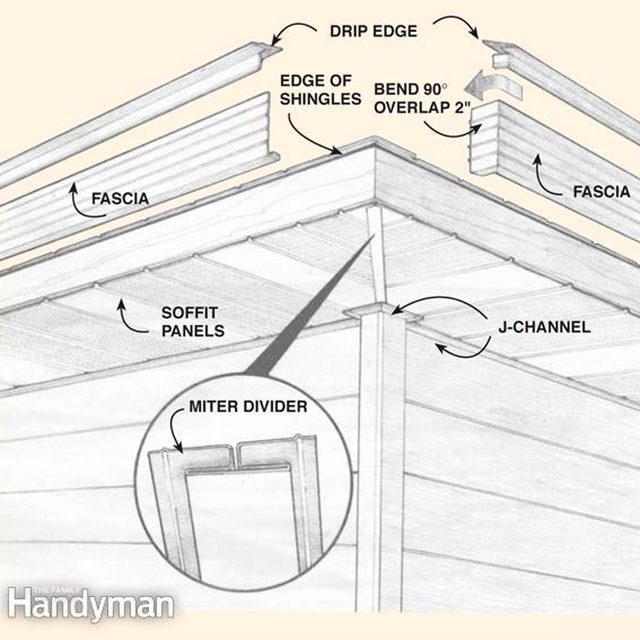
Shop for these standard parts. Other special parts are likewise bachelor.
Note: You tin can download and print Figure A from the Boosted Data department below.
Project step-by-step (17)
Stride 1
Prep the erstwhile roof edges
Prep the soffit

Remove existing shingle molding and frieze boards and supervene upon whatever rotten fascia. Cut in additional soffit venting where necessary and remove existing soffit grilles to improve airflow.
Begin the job by pulling off the gutters. Removing gutters can exist a real drag, simply they may be reusable—if they survive the removal intact and if the color matches the new trim. Some aluminum styles are easily kinked, and so take someone assistance you take them down. If you're planning to reuse them, get out the drainpipes in place and simply disconnect them at the elbows. Steel yourself; you may cease up having to supersede the gutters along with the new trim if things don't go well.
Virtually homes already take soffit vents. They conduct outside air into the attic to help prevent water ice dams in the wintertime and continue attics cool in the summertime. Information technology's best to remove existing vent covers for freer airflow before installing ventilated soffit panels. You should have about 1 sq. ft. of vents for every 300 sq. ft. of ceiling surface area, so add more holes if you lot're lacking ventilation. The holes don't need to be pretty; they'll be covered with new material. For ease of cut, position new holes in the spaces between the soffit framing (await for soffit nails to locate). For even ventilation, space holes fairly evenly across each soffit department.
Fascia board repair
The old wood fascia boards must be audio plenty to hold the new fascia nails. Cheque the woods quality past jamming a screwdriver tip into the wood. Replace punky or rotten wood with straight pino boards the same width and thickness equally the old.
Shingle moldings are narrow trim boards nailed to the acme of the fascia if gutters aren't used. They, like drip edge, straight water runoff abroad from the face to prevent weather condition damage. Pry them off with a flat bar and pull whatsoever leftover nails to fix for the aluminum.
If the house has frieze boards (trim boards directly beneath the soffits), pull them off unless their removal leaves an unfinished gap between the siding and the new soffit. If that's the case, leave information technology and butt the J-aqueduct against it. Removing the frieze board is optional. Do information technology if you ever expect to supplant your siding. That way, you'll exist able to strip off the old siding without wrecking the new soffits.
Aside from the jigsaw, none of these tools costs much, so information technology's commonly cheaper to buy rather than rent them. Habitation centers carry the same quality tools the pros apply.
- Pair of tin snips for cutting straight lines.
- Pair of right or left cut snips for cutting curves, if yous have circles to cut (for example, round lights and electrical boxes).
- Trim blast punch for holding and setting nails into soffit grooves and tight places. Combination square for making clean fascia bends to go effectually corners.
- 12-in. folding tool for making minor bends in fascia. Jigsaw for cutting vents and removing projecting corners.
- Carpenter'south square for squaring up the first soffit panel to the house.
- Hammer, utility knife, tape measure, chalk line.
Yous Gotta Build this Quick, Cheap and Piece of cake Cut Table!
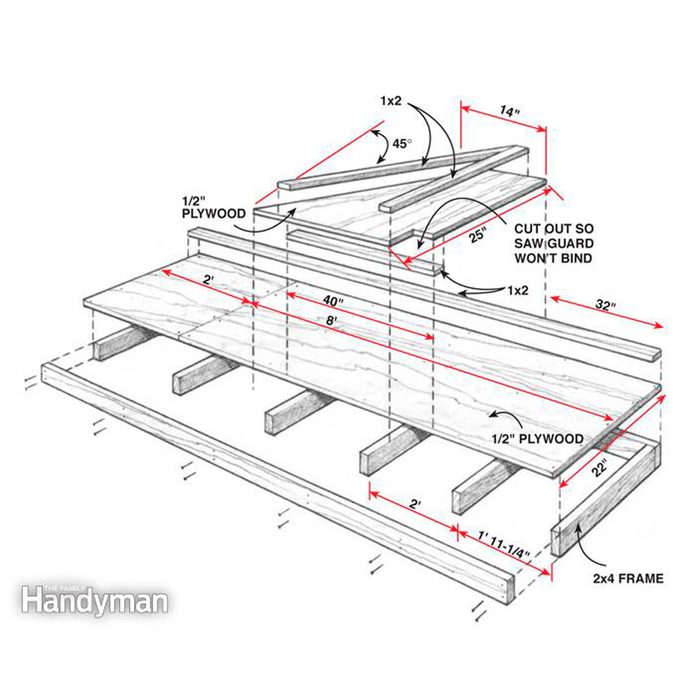
Cutting dozens of soffit panels with a pair of snips is tiring and crushes the grooves together. A circular saw makes clean, precise cuts easy—when it'south coupled with a cut table. Y'all can make a plywood-cutting table (Fig. B) in near an 60 minutes. The 45-degree side of the tabular array is for cut miters on hip roof soffits (meet "How to Handle Soffit Corners on Hip Roofs.").
Use a plywood crosscutting blade mounted backward—the saw teeth point down in a clockwise management. Before reversing the blade, make a pass halfway through the top of the plywood saw table to create a saw bract groove. This allows the blade to cut completely and cleanly through the aluminum. For multiple cuts of the aforementioned length, clamp a stop block to the table contend. Cut panels ane/4 in. short of the measured width. Caution: Wearable hearing and eye protection.
Notation: Yous tin download and impress Figure B from the Additional Information section below.
How to Make clean Soffit Vents
Stride two
Install the soffit panels
Install aluminum J-aqueduct
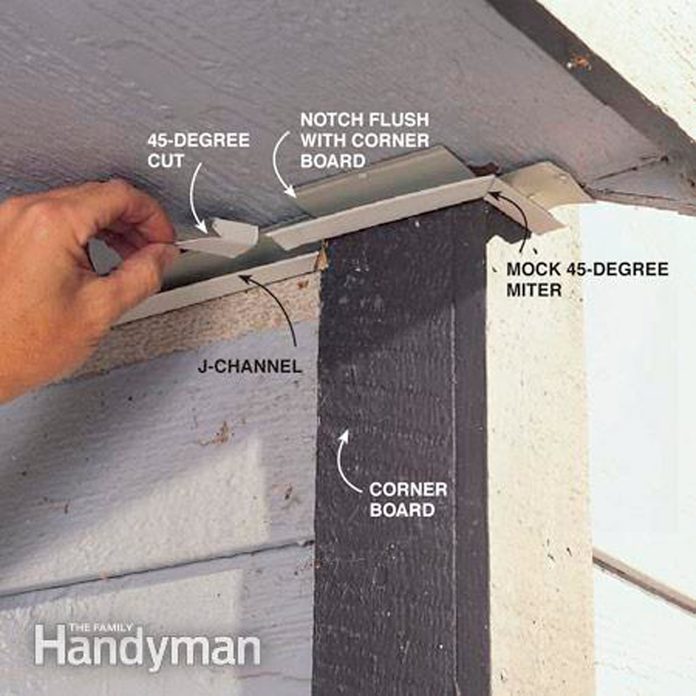
Nail J-aqueduct against the existing soffit into the soffit framing. On corners, notch the summit and backside of the J-channel the width of corner boards and cut the bottom to extend by corner boards the width of the side by side slice. Cut a 45-degree angle on bordering pieces to give a mock miter appearance to corners.
How to Build a Soffit Box with Recessed Lighting

Pace 3
Measure and cut soffit panels

Mensurate the distance from the inside of the J-channel to the outside of the wooden soffit at several locations to brand sure the soffit depth is consequent. Cut soffit panels 1/4 in. shorter than the measurement. If there are variations in depth, arrange cutting lengths accordingly.
Prevent Ice Dams
Step 4
Nail upwardly the panels

Skid the first panel into the J-channel against the wall with the groove side toward the installation direction. Square up the panel to the business firm with a carpenter's square and nail the outside of the panel to the bottom of the wooden fascia. Use a trim smash dial to drive 1-1/2 in. soffit nails into each of the outer Five-grooves, the groove flange and the middle groove of panels that have center backing.
Improve Cranium Ventilation: Introduction
Step 5
Join and boom additional panels
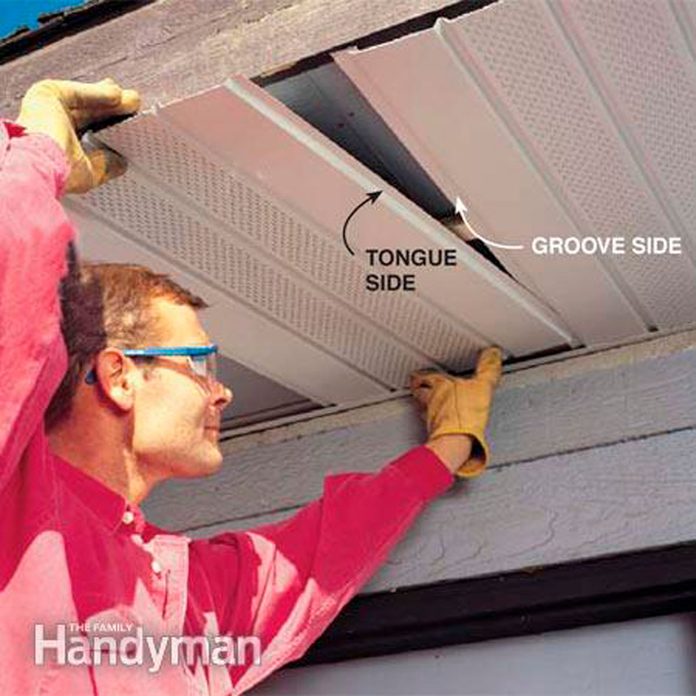
Sideslip the corner of the tongues of consecutive panels into the grooves of the previous panels and slip the sides nearest the house into the J-channel, mating the tongues and grooves at the same fourth dimension.
How to Meliorate Attic Ventilation
Step 6
Cutting holes for lights
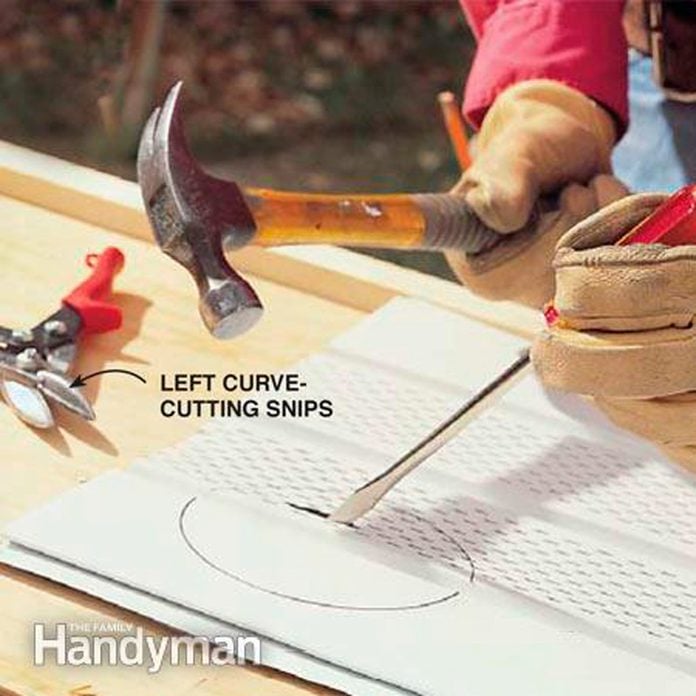
Cut circular openings for soffit lights by driving a screwdriver in the center of marked circles to make an entry point for curve-cut snips. Recessed lights accept housings with adjustable Fly-Nuts to drib the cans down flush with the new surface. Extend conventional electrical boxes with extension rings to bring them down flush with the aluminum.
The job goes smoother when you follow the correct installation sequence. First nail up the J-channel, so soffit panels, and then fascia, and then drip edge. It's a hassle to continually motility your ladders (or scaffolding) and cutting table effectually the house, then concentrate on completing i overhang at a fourth dimension until you go to the corners. Then you'll have to jump dorsum and forth between gable and eave ends when you're finishing tying the corners together. The trick is to end equally much equally possible on one soffit earlier moving all the gear.
This isn't the time to be a cheapskate. Rent scaffolding for loftier areas. If you're blessed with a 1-story dwelling, yous can practice the whole job with stepladders. But if you lot have loftier ambitions, similar working on 2d-story soffits, y'all'd best get to the rental one thousand and order up section-style, steel scaffolding. Measure the pinnacle of your soffits and the rental clerks will assist y'all put together the right parts. You'll pick upward speed when you conquer the basics of soffit installation, but for the average sized house you should plan to rent the scaffolding for at least a week. Before you rent it, take care of the low soffits with ladders to salve rental costs.
CAUTION! Be careful not to contact overhead power lines.
Call the power company for help with electrical lines that are almost or pass through soffits or fascias.
Follow the step-by-pace photos for complete step-by-pace installation instructions for soffit panels. The devil is in the details. The deviation between poor and quality workmanship is obvious when you examine well-baked corners, clean miters and flat surfaces. Here's the of import stuff:
J-channel tips: Nail J-aqueduct in identify tight confronting the existing soffit with one-1/four in. shingle nails driven into the soffit framing. Spend time on corners. You'll be looking at them for a long time.
Soffit panel tips: Apply a carpenter's square to install the first soffit panel perpendicular to the firm with the groove side toward the direction you're installing. Oftentimes you'll need to notch and fit the offset and final panel around corners and trim. The ones in between the ends practically install themselves.
The J-channel anchors the house side soffit edge. Boom the opposite soffit edge to the bottom edge of the wooden fascia. Identify one blast in each of the outer 5-grooves and in the lip of the groove flange. For soffits that are wider than 2 ft., put a nailer across the center of the soffit for more support. Nail the lath to the bottom of the wooden soffit by driving 2-in. nails into the soffit framing members.
Nailing tips: Spike all aluminum trim with one-one/two in. aluminum or stainless steel nails, color-coated to match the trim. Select stainless if in that location'southward a choice. They hold ameliorate and don't curve every bit readily as aluminum nails. A trim nail punch has a recessed sliding driver that not only holds nails while you pound (saving smashed fingers) just also allows you to set up nails in deep crevices where the hammer tin't reach. Purchase i!
Aluminum Siding: Stop the Noise
Step 7
How to Handle Soffit Corners on Hip Roofs

Hip roofs are pyramid-shaped, so all the roof surfaces slope up from the eaves. All the roof edges are eaves (no gable ends), and then flat soffits go on effectually corners. Fit soffit around corners by installing back-to-dorsum J-channel or miter divider to handle the splice. Brand 45-degree cuts on panels using the 45-degree feature on your soffit table. See Figure A.


fifteen Silent Signs That Your Roof is Declining
Step viii
Install the facia panels and baste edge
Create a flat fascia surface

Saw off projecting trim on corners of boxed returns for smooth, well-supported aluminum corners. "Fur out" the ends of returns to make them flush with the existing fascia for a flat surface all the way up to the shingles.
13 Simple Vinyl Siding Installation Tips
Step 9
Cut and bend corners

Add together the back and side of the return to go the total distance. For a clean bend, notch the bottom lip with two 45-degree cuts and bend the corner using a combination square.
How to Force per unit area Launder a Business firm
Step 11
Trim the second piece

Cut another identical length of fascia and remove the lip. Orient the aluminum fascia upside down to utilize the elevation, swell factory border on the bottom where it shows. Bend it and cut it to fit around the boxed return, lapping over the bottom piece of fascia 1/2 in.
28 Annoying Dwelling Noises and How to Eliminate Them Forever
Step 12
Install the gable fascia

Install the lowest fascia on the gable end first. Remove plenty of the fascia lip to cover returns, and then nail them in place and cut the ends off affluent with eave ends. Either curve or clip the bottom tip flush with the lesser of the soffit.
Finishing an Attic
Step thirteen
Trim the peak

Run one fascia long at gable peaks. Concur the second overlapping slice in position and draw a vertical line with a level for the top cutting.
Step fourteen
Curve corners crisply

Bend the ends of horizontal fascias with a 12-in. folding tool to cleanly wrap effectually corners. Concur corners tight with two nails.
Slash Heating Bills
Step 15
Trim the baste edge

Cut aluminum fascia, soffit and drip border to width past scoring it with a sharp utility knife. Guide the score with a straightedge for apartment piece of work. So either peel back the material or bend it back and forth until it snaps off. You lot could utilise metal snips, but this method yields a cleaner, straighter cut.
25 Hints for Fixing Roof and Gutter Issues
Stride 16
Install the drip edge

Slip drip border under all covering material and face-boom it through the aluminum fascia. Notch the tops of corners to interlock flanges and curve the bottom around for a peachy advent.
Follow the photos higher up for complete footstep-past-pace installation instructions for the fascia and baste edge.
Fascia tips: Use extra care nailing up the aluminum fascia. Hammer dents and bent or overset nails actually show up subsequently. Brainstorm installing aluminum fascia at the center of each length by pushing it upwards snug to the lesser of the soffit panels. Nail it, then work your mode in both directions, driving nails every xvi in., placed about 1 in. from the top and bottom. Overlap joints 1 to two in. and nail through the lap. On slopes, like eave ends, work your mode uphill with the lowest fascias first. That manner, lapped joints will shed water.
Older Homes Call for Creative Solutions
Instead of the flat "boxed" soffits shown in this article, older (and some newer) homes may have a soffit style that features either exposed rafter tails or enclosed soffits that follow the gradient of the roof.
Aluminum soffits tin also be angled to follow the slope of the roof. Or you can convert sloped soffits to apartment with 2x4s to provide a nailing course for the aluminum trim. Since there won't be a soffit to nail J-channel to, it has to be fastened to the wall. Cut 1-in. wide notches every two ft. in the long leg of J-channel and bend it up. These tabs can then be nailed to the wall. An alternative is to nail F-aqueduct (serves the same purpose as J-channel, just the F-shape lets y'all smash the flange to the wall) flush with the line, upside down to receive the soffit.
Ladder Stabilizers
Footstep 17

If yours is a classic old home with elegant detailing on the eaves, call up twice before yous hide all that innate dazzler behind manufactured materials. If the eaves can be restored, you may desire to roll up your sleeves and exercise information technology the old-fashioned way.
Buy Tiptop-notch Materials—They're Easier to Install and Will Terminal for Decades
Aluminum soffits come in a lot of different colors, but yous'll probably discover only brownish and white at most home centers and lumberyards. If you'd like a greater selection and usually college-quality materials, await under "Siding Materials" in the Yellow Pages to detect out where the pros shop.
Most suppliers volition sell to the public. Manufacturers of premium-form aluminum apply thicker-gauge metal with sturdier edges, and so the soffits are more resistant to kinking and denting. Their colour finishes are less likely to scratch or wearable off and they hold colour tones better over time. They also supply complementary colors in siding if you determine to go the adjacent step and make your whole house maintenance gratuitous.
How to Install a Natural language and Groove Ceiling
Boosted Data:
- Figure A: Aluminum soffit and fascia parts
- Figure B: Cutting table
Originally Published: February x, 2022

Source: https://www.familyhandyman.com/project/how-to-install-aluminum-soffits-that-are-maintenance-free/
Posted by: kindigthesne.blogspot.com
0 Response to "How To Install Aluminum Soffit And Fascia Video"
Post a Comment